

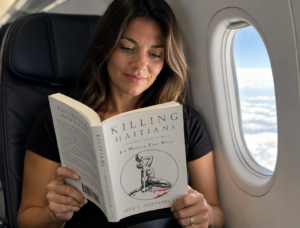
The best travel books do more than occupy a few hours on a flight. They transport readers into unfamiliar places, reveal lives far removed from their own, and make the surrounding world feel larger. Killing Haitians: A Mission Through Hell & A Haitian Love Story delivers that experience through an intense firsthand account of danger, compassion, cultural conflict, personal failure, and survival.
Written by Max C. Sconyers Jr., the book follows a thirty-day journey through Haiti that became far more dangerous than the author could have anticipated. Sconyers describes being held at gunpoint, kidnapped, injured, rescued, and confronted with violence that most travelers will never witness. The result is a travel memoir that carries the urgency of a thriller while remaining rooted in personal experience.
For readers who enjoy books that make a long flight seem short, this is a compelling choice. It is emotionally demanding, fast-moving, and difficult to put down. It also offers something many conventional travel narratives avoid: an honest look at how quickly a journey can move beyond a traveler’s control. 📖✈️
A Travel Story That Refuses to Stay Comfortable
Many travel memoirs follow a familiar path. The writer arrives in a new country, encounters unfamiliar customs, samples local food, meets colorful personalities, and returns home with amusing stories. Killing Haitians follows a far more unsettling route.
The journey begins with good intentions, but those intentions offer little protection once the author enters situations shaped by fear, confusion, violence, and unpredictable human behavior. Sconyers is not presented as a perfectly prepared adventurer who always knows what to do. He arrives with his own emotional struggles, personal flaws, assumptions, and vulnerabilities. Those weaknesses become part of the story rather than details hidden to make the narrator appear heroic.
That honesty gives the book much of its power. Readers are not watching an invincible character survive a carefully designed fictional crisis. They are following a real person whose judgment, mental state, and decisions carry consequences.
The author’s account belongs among the most memorable True survival stories in Haiti because the danger is never separated from the people involved. Every threatening encounter includes human decisions, and every moment of rescue depends on someone choosing to intervene.
Thirty Days That Read Like a Thriller
Thirty days may appear brief on a calendar, but the events described in the book give that period enormous weight. During his travels, Sconyers reports being held at gunpoint, kidnapped, physically injured, and eventually rescued. He also describes witnessing the beating and deaths of two Haitians. These experiences form the foundation of a memoir that moves with the tension of a suspense novel.
The difference is that a fictional thriller promises safety to the reader. A novelist can arrange every escape and determine exactly when the hero reaches shelter. A firsthand survival account carries a different kind of uncertainty. The person describing the ordeal once lived through it without knowing how the next hour would end.
That uncertainty remains present throughout Killing Haitians. A misunderstanding can escalate. A wrong turn can become dangerous. A person who seems helpful can introduce another risk. Safety depends on awareness, restraint, timing, and sometimes the compassion of a stranger.
The book does not treat danger as an entertaining attraction. It shows how fear narrows a person’s attention and changes every calculation. Once a weapon appears or freedom disappears, ordinary concerns lose their importance. Survival becomes immediate.
Haiti Is More Than a Backdrop
A weaker book might use Haiti merely as an exotic setting for one man’s ordeal. This memoir attempts to show a country filled with people, relationships, beauty, suffering, courage, and contradiction.
Understanding that complexity matters. Haiti’s history includes revolution, independence, foreign intervention, political upheaval, artistic achievement, religious tradition, economic hardship, and repeated natural disasters. No single book can represent the full experience of an entire nation, but a responsible travel memoir can acknowledge that the country exists beyond the visitor’s personal crisis.
Haiti also possesses significant cultural and historical landmarks. The National History Park—Citadel, Sans Souci, Ramiers is recognized by UNESCO as a World Heritage Site. Places such as these reflect the country’s history, architectural achievement, and enduring national identity.
Killing Haitians becomes more meaningful when read with this broader understanding. The author’s experience is one personal account, not a complete definition of Haiti or the Haitian people. The book presents violence and suffering, but it also records human connection, rescue, affection, and generosity. Those elements prevent the narrative from collapsing into a simple story about a frightening destination.
The Human Side of Rescue
Survival stories naturally focus on the person who escaped, but rescue rarely belongs to one person alone. Someone notices the danger. Someone decides to help. Someone takes a risk, opens a door, provides information, offers transportation, or stands between another person and harm.
That human element gives Killing Haitians emotional depth. Rescue is not presented as a convenient turn in the plot. It comes through relationships and decisions made by people whose actions affect whether someone else lives, escapes, or remains trapped.
This makes the story about more than physical endurance. It becomes a study of dependence. Travelers often value independence, but international travel repeatedly reveals how much every person depends on drivers, hosts, translators, medical workers, local families, officials, and strangers.
The memoir captures the frightening side of that dependence while also showing its beauty. The same journey that exposes cruelty can reveal courage. The same country in which the author encounters violence also becomes the place where people help preserve his life.
A Valuable Book for Thoughtful Travelers
Reading a book about travel is not the same as preparing for travel. Conditions change, transportation routes are altered, public-health guidance is updated, and security risks can develop quickly.
Current destination research should always come from reliable sources. The U.S. Department of State’s Haiti Travel Advisory provides official security information for American travelers. As of July 2026, Haiti remains under a Level 4 “Do Not Travel” advisory because of serious safety concerns.
Health preparation is equally important. The CDC Haiti Traveler View offers destination-specific information concerning vaccines, disease risks, insect precautions, food and water safety, and medical preparation.
These resources reinforce one of the book’s central lessons. Good intentions do not replace preparation, and confidence does not eliminate risk. A traveler may be intelligent, experienced, and compassionate while still being unprepared for a rapidly changing situation.
Killing Haitians should not be treated as a travel guide or a prediction of what every visitor will experience. Its value lies in revealing what happened to one traveler and how those experiences affected him. It encourages readers to take unfamiliar environments seriously and to respect the difference between curiosity and recklessness.
Why It Belongs in Your Carry-On
The ideal travel book must compete with airport noise, flight announcements, uncomfortable seats, crowded terminals, and the temptation to watch another movie. It needs a strong opening, clear momentum, vivid scenes, and enough emotional depth to remain memorable after the trip ends.
Killing Haitians has those qualities. The danger creates immediate suspense, while the personal reflections give the story weight beyond the individual incidents. Readers are not simply waiting to discover whether the author escapes. They are watching his understanding of himself, Haiti, faith, fear, and human nature change under pressure.
The book is especially well suited for travelers who enjoy memoirs, international accounts, survival narratives, Christian social themes, and stories that combine physical danger with personal reckoning. Its subject matter is serious, but its narrative momentum makes it accessible during a flight, train journey, cruise, hotel stay, or quiet evening away from home.
Travel also creates the right mental space for a book like this. Leaving familiar routines often makes readers more receptive to stories about uncertainty and change. While moving between destinations, the reader can better appreciate the emotional distance between the person who begins a journey and the person who eventually returns.
A Story That Connects Personal Experience With Current Events
Haiti continues to appear in international reporting because of political instability, displacement, armed violence, humanitarian needs, and transportation disruptions. The United Nations’ Spotlight on Haiti provides continuing information about the country’s humanitarian conditions and international response.
Travel and transportation developments also demonstrate how quickly conditions can change. A recent Reuters report concerning the planned resumption of American Airlines service described proposed flights to Cap-Haïtien while also noting continuing aviation restrictions affecting Port-au-Prince.
These reports provide useful context, but news coverage usually focuses on major developments, official statements, numbers, and public events. A memoir operates differently. It places the reader inside a particular person’s fear, confusion, hope, and memory.
That difference is why personal accounts remain valuable. Statistics can describe the scale of a crisis, but they cannot fully reproduce the sensation of facing a weapon, losing control of one’s movement, depending on unfamiliar people, or realizing that survival is no longer guaranteed.
More Than a Collection of Dangerous Encounters
The subtitle, A Mission Through Hell & A Haitian Love Story, signals that the book contains more than violence. The journey includes affection, relationships, spiritual reflection, and the search for meaning after traumatic events.
Physical escape does not automatically create emotional peace. A survivor may return home while continuing to carry grief, anger, fear, guilt, and unanswered thoughts about the people who did not escape. The strongest sections of the memoir recognize this continuing burden.
Sconyers does not present himself as an untouchable hero. His account contains vulnerability and personal disorder alongside courage and endurance. That approach makes the book feel less like a legend created after the fact and more like an attempt to understand experiences that permanently changed him.
Readers may disagree with some of his choices or interpretations, but that tension strengthens the reading experience. A worthwhile memoir does not require the audience to approve of every decision. It allows readers to consider how they might respond under pressure while recognizing that calm judgment becomes far more difficult when danger is real.
Conclusion
Killing Haitians: A Mission Through Hell & A Haitian Love Story stands out because it combines the urgency of a survival thriller with the emotional complexity of a personal memoir. The author’s thirty days in Haiti include kidnapping, violence, injury, rescue, affection, spiritual struggle, and a confrontation with his own vulnerabilities.
The book does not offer a comfortable vacation story. It offers a difficult journey through circumstances that changed without warning and carried consequences that followed the author home. Haiti emerges as a country of sharp contrasts, where suffering and kindness, danger and beauty, fear and human connection can exist beside one another.
For readers seeking a gripping book for their next flight, road trip, cruise, or hotel stay, this memoir provides suspense with substance. It can make the miles pass quickly while leaving behind thoughts that last much longer than the journey.
Some books help travelers escape the world for a few hours. Killing Haitians asks them to look more closely at it. 🌍📚